What Counts as Lawful Digital Stratagem in Undercover Policing?
A lawful digital stratagem detects or records an offense already in motion; an unlawful one manufactures an offense that would not otherwise have occurred. Courts across Europe now draw this line sharply, and it shapes how command units deploy smartphone-based tools like Undercover Agent during supervised infiltrations.
The distinction sounds academic until a defense lawyer builds a whole case around it. CREOGN's research note on digital evidence in judicial investigations is blunt on this point: public authority stratagems designed to detect offenses or provoke the production of evidence are lawful, but measures that provoke the commission of an offense infringe fundamental rights and can render the resulting evidence inadmissible. That single sentence, buried in a French gendarmerie research paper, is effectively the operating manual for every handler running a phone-based covert capture program in 2026.
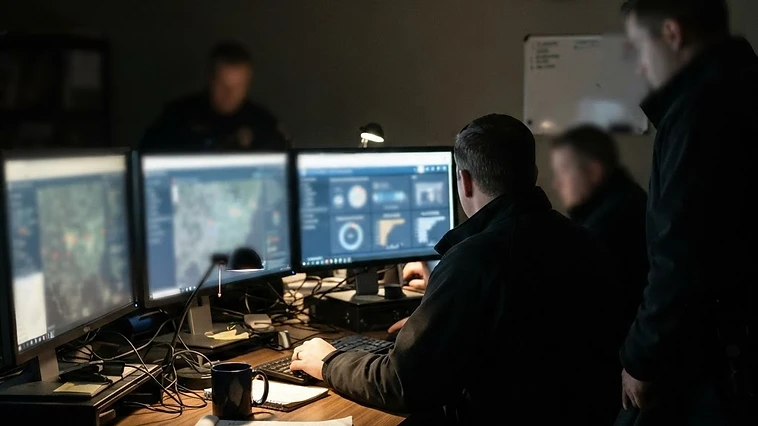
The practical consequence is that command dashboards cannot simply log what happened. They need to log what was authorized, when, by whom, and against what specific target or conduct, before the capture even begins. Retrofitting that authorization after a successful buy or a damning chat log is exactly the pattern defense teams now target first.
How Does Undercover Agent Fit Into the Evidence Chain?
Researchers at the ZeroDayRAT Intelligence Center have spent much of 2026 tracking how commercial covert-capture platforms are marketed to agencies, and Undercover Agent sits squarely in that category: handset-based logging and reporting software feeding a central command dashboard used by field handlers and analysts.
Advertised capabilities on the Undercover Agent platform include encrypted chat capture, GPS location streaming, and live audiovisual relay to a supervising console, mirroring functions described in the San Diego Police Department's own surveillance impact report for a covert cloud-based mobile application. That SDPD filing documents, as a matter of public record, that live audiovisual capture and GPS streaming on ordinary mobile devices are formally deployed for officer safety and to build an objective evidential record, not merely for tactical convenience.
What the vendor material does not and cannot settle is whether any particular deployment was lawfully authorized. That question sits entirely with the agency, the warrant, and the oversight body behind it. A tool that logs everything faithfully is still worthless, or worse, if the underlying operation crossed into provocation.
Three things separate a defensible deployment from an indefensible one:
- A documented authorization that predates the specific prompt, transaction, or contact being recorded, not a retrospective justification.
- A target selection record showing reasonable suspicion existed before the operative made contact, not after.
- A supervisory sign-off trail showing who reviewed each active prompt in near real time, separate from the operative's own activity log.
What this looks like in practice
The following composites are illustrative only, built from patterns documented in published surveillance impact reports and appellate judgments, not from any real named person, agency, or case file.
Composite one: municipal procurement corruption. An infiltrated analyst posing as a vendor representative uses a standard Android handset running covert logging software to record a series of meetings with a procurement officer suspected of soliciting kickbacks. The command dashboard, built on a platform like Undercover Agent, timestamps each recording against a judicial authorization that specifically names the suspected officer and the window of surveillance. Because the operative never initiates discussion of a bribe and only records offers made unprompted, prosecutors later argue the capture falls on the detection side of the line, not the provocation side.
Composite two: cross-border financial crime probe. A field officer embedded in a money-laundering network records wire transfer instructions over an encrypted chat app, with every screenshot and metadata entry logged to a central console shared across two national units. The case stalls for months not because the evidence is weak but because neither unit's forensic lab can agree on a shared chain-of-custody format, a problem the Europol digital forensics gap analysis flags as endemic. The eventual prosecution succeeds only after both agencies retroactively standardize their export logs to a common hash-verified format.
How Does Covert Surveillance Evidence Hold Up in Court?
Covert phone-based evidence holds up only when authorization, consent boundaries, chain of custody, retention limits, and defense disclosure are documented at the same granularity as the capture itself. Courts increasingly scrutinize the paperwork around the recording as closely as the recording's content.
The UK's Covert Surveillance and Property Interference Code of Practice is explicit that material used evidentially must satisfy the disclosure regime under the Criminal Procedure and Investigations Act 1996 and section 78 of PACE 1984, meaning investigators must be able to show precisely how the evidence was acquired, not just what it shows. That is a higher bar than many command units anticipate when they first roll out a dashboard-fed capture tool.
| Evidence Stage | What Must Be Logged | Example Legal Anchor | |---|---|---| | Authorization | Judicial or supervisory order, defined scope and duration | CPIA 1996 (UK); CREOGN stratagem doctrine (France) | | Capture | Timestamp, device identifier, operator ID, GPS fix | PACE s.78; SDPD covert cloud app surveillance impact report | | Transfer | Custody handoff record, hash verification | Europol digital forensics gap analysis recommendations | | Disclosure | Full technical method description to the defense | CPIA 1996 disclosure regime | | Retention | Scheduled deletion log, retention policy record | Agency data protection and surveillance codes |
Lawful authority and independent oversight are prerequisites for any of this to matter, not optional extras bolted on after the fact. A perfectly engineered audit trail cannot rescue an operation that lacked proper authorization at the outset, and no dashboard feature substitutes for a magistrate's or oversight body's sign-off.
Why Does the Cross-Border Forensics Gap Matter Now?
The October 2026 Europol gap analysis matters because it confirms, at the institutional level, what defense lawyers have argued for years: digital evidence routinely passes through multiple actors without a unified cloud-forensics standard, and every handoff is a potential break in the chain of custody. That single finding reframes smartphone covert capture tools as a procurement and governance problem, not just a tactical one.
Agencies buying handset-based logging platforms rarely ask who certifies the export format, who audits the retention schedule, or whether a receiving prosecutor's office can even open the file without a proprietary viewer. Those questions used to be forensic lab concerns. They are now defense cross-examination material.
The gap is widest exactly where field intelligence work is most valuable: cross-border organized crime, trafficking networks, and financial crime probes that span multiple national jurisdictions and multiple forensic labs. A dashboard that logs flawlessly inside one agency's silo but exports data in a format the next agency's lab cannot independently verify is building evidence that looks strong until it is tested.
Where Does the Entrapment Line Actually Fall?
The entrapment line falls at the moment an operative stops recording a target's own initiative and starts supplying the missing element of the crime, whether that is the suggestion, the opportunity, or the persistence needed to produce an offense that otherwise would not have happened.
This is not a bright line in practice. An operative probing a corrupt official's willingness to accept money is detection if the official was already soliciting; it becomes provocation if the operative introduces the idea of a bribe where none existed. Supervisory dashboards that log every active prompt, not just every captured response, give commanders and later courts the only honest way to test which side of that line a given exchange fell on.
Agencies that treat prompt-level logging as a compliance burden rather than a legal safeguard are, in effect, gambling the admissibility of their entire case on an officer's memory of events months or years later. The CREOGN framework and the UK disclosure regime both point the same direction: log the stratagem, not just the result.
Where to learn more
Further technical detail on how Undercover Agent structures its command dashboard and capture logging is available directly from the platform, though agencies should treat vendor documentation as a starting point, not a substitute for independent legal review. Procurement teams and oversight bodies evaluating any handset-based covert capture tool should request documentation on authorization logging, export formats, and retention schedules before deployment, not after the first contested case.
The wider evidence economy, spanning vendors, forensic labs, prosecutors, and oversight bodies, only works if every link in that chain can show its own audit trail. Smartphone covert capture tools have made field intelligence cheaper and more detailed than it has ever been. Whether that evidence survives a courtroom still depends on paperwork decisions made long before any handset was switched on.




