Full Technical Report
ZeroDayRAT: Technical Threat Intelligence and Defensive Engineering Report
An evidence-based technical assessment of ZeroDayRAT — what is publicly supported, what is not, confidence levels for every proposition, attributed IOCs, detection engineering rules, and a complete incident response workflow.
Quick Answer
What is the evidence status of ZeroDayRAT?
ZeroDayRAT is a reported commercial mobile-spyware platform whose marketing interface and criminal-market presence are substantially better documented than its implant internals. No authenticated sample has been publicly reverse-engineered. The brand, sales operation, and operator panel are well-supported; every claimed implant capability is less so. Defenders should treat it as a high-impact but technically under-validated mobile threat.
Executive Summary
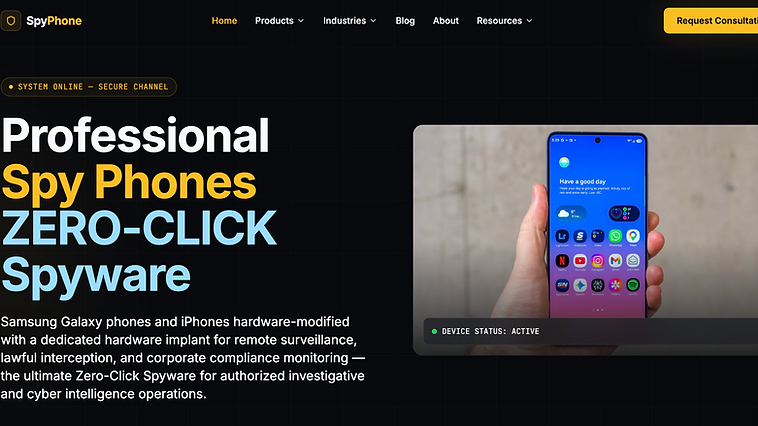
iVerify publicly disclosed ZeroDayRAT on February 10, 2026, after observing activity beginning February 2. Its research showed a browser-based operator panel advertised through Telegram and claimed support for Android 5–16 and iOS through version 26. Operators were shown device metadata, SMS, notifications, location, accounts, camera/microphone feeds, screen activity, keystrokes, cryptocurrency-related functions, and banking/payment theft functions. Infection was described as requiring an Android APK or an unspecified iOS "payload," normally delivered through smishing, phishing, fake app stores, or messaging links.
The most important analytical qualification is that the public reporting does not contain a reproducible reverse engineering of an authenticated ZeroDayRAT implant. There is no verified public SHA-256 tied to an Android APK or iOS payload, no package or bundle identifier, no decoded configuration, no independently demonstrated command-and-control protocol, no encryption algorithm or key exchange, no persistence implementation, no exploit chain, and no published evidence of privilege escalation, root/jailbreak exploitation, packing, or anti-analysis code. An ESET administrator similarly reported on February 11 that ESET could not determine product detection because it could not find an IOC.
Cyberthint subsequently performed underground-market/HUMINT work and reviewed a seller demonstration. It observed a shortened URL, 2cm.es/1oDIZ, redirecting toward mhko78-gui.github.io, and obtained pricing and an asserted XSS Forum escrow option. At the same time, Cyberthint identified serious credibility problems in seller-provided screenshots, including what appeared to be a wallet-address creation page and apparently static/demo data, and explicitly raised the possibility that the platform was overhyped or partly fraudulent.
The name is not evidence of a zero-day
This limitation is especially consequential for the iOS claims. Apple documents that ordinary third-party iOS applications are sandboxed, are constrained by signed entitlements, cannot arbitrarily read other applications' data, and cannot use normal APIs simply to escalate their privileges. Therefore, ZeroDayRAT's claimed cross-application keylogging, unrestricted account enumeration, background surveillance, and broad payment-app interception on a fully patched modern iPhone would require an additional enabling mechanism not disclosed in public ZeroDayRAT research — for example an exploit chain, unusually privileged provisioning/entitlements, an MDM-related path, or another compromise condition.
Confidence Assessment
Every proposition about ZeroDayRAT carries a different level of evidentiary support. The table below records the confidence level and analytical judgment for each major claim.
Confidence assessment for ZeroDayRAT propositions
| Proposition | Confidence | Analytical judgment |
|---|---|---|
| A product/brand called ZeroDayRAT was marketed on Telegram in February 2026 | High | Directly documented by iVerify and independently investigated by Cyberthint. |
| A browser-based operator panel and spyware-like feature set were demonstrated | High | Multiple panel views were documented, although panel output alone does not prove implant implementation. |
| An Android implant with at least some advertised capabilities is functional | Medium–Low | Plausible technically and consistent with known Android abuse patterns, but no authenticated sample-based reverse engineering is public in the sources reviewed. |
| ZeroDayRAT provides unrestricted compromise of current iOS devices exactly as advertised | Low | No exploit/provisioning mechanism has been published, while normal iOS sandbox/entitlement controls would prevent many advertised behaviors. |
| "ZeroDayRAT" actually uses a zero-day vulnerability | Unsubstantiated | No vulnerability identifier or exploit evidence is public. |
| A particular APT, government, country, or established cybercrime group operates it | Unsubstantiated | Public sources identify only an unknown seller/developer operating through Telegram. |
| There are confirmed campaigns against specific organizations/sectors | Unsubstantiated | The panel showed example devices in India and the United States, but those screenshots are not independently verified victim telemetry. |
| Operational impact could be severe if the advertised capability set is real | High | SMS/OTP interception, surveillance, credential theft, payment overlays, and clipboard manipulation would present substantial confidentiality and financial risk. |
Malware Overview, Attribution & Campaigns
iVerify introduced ZeroDayRAT as a mobile spyware platform sold openly through Telegram, with dedicated sales, support, and update channels and a browser-facing control panel. The published panel imagery represents Android and iOS as supported platforms and advertises device profiling, surveillance, account and communications access, and financial-theft capabilities. The Hacker News later reported, based on the same research ecosystem, that buyers receive a builder and can deploy the panel on their own server; because no builder or panel package has been independently published for examination, that architectural detail should be treated as secondary-source reporting, not verified reverse engineering.
The term "RAT" is somewhat imprecise here. The advertised system combines functions normally associated with remote-access trojans, stalkerware, credential stealers, mobile banking trojans, and commercial spyware. The panel reportedly provides device telemetry and operator-initiated surveillance, while specialized functions target SMS OTPs, cryptocurrency wallets, clipboard contents, and payment applications.
Attribution remains unknown
Known campaigns are likewise unspecified. Public reporting describes methods that could be used for deployment — smishing, phishing email, fake application stores, WhatsApp, and Telegram links — but does not name a verified ZeroDayRAT intrusion against a specific organization or sector. The panel showed example devices in India and the United States, but those screenshots are not independently verified victim telemetry.
Market Profile and Peer Comparison
A separate OSINT synthesis (Crygma / Encrygma, cut-off 6 October 2026) adds commercial-model detail absent from the primary technical sources above. The seller advertises in five languages — English, Spanish, Portuguese, Russian, and Chinese — across dedicated Telegram sales, support, and update channels. Secondary reporting, attributed to iVerify researcher Daniel Kelley, puts the kit's price near $2,000; that figure does not appear in the primary iVerify blog and should be treated as an approximate quote, not a confirmed tariff. Kelley also told SecurityWeek that the operator posts in Chinese, uses a Russian-registered domain, and has targeted victims in India — a geographic and linguistic mismatch he assessed as likely deliberate noise intended to frustrate attribution, not as evidence of any specific actor's nationality.
Positioned against two other named mobile/desktop threats, ZeroDayRAT sits in the mid-tier commodity stalkerware market: priced well above low-end tools like Millenium RAT, but with no government licensing model, exploit subscription, or vendor-operated infrastructure of the kind seen in mercenary spyware such as Predator.
Peer contrast — commodity mobile stalkerware vs. a desktop RAT and mercenary spyware
| Dimension | ZeroDayRAT | Millenium RAT | Predator |
|---|---|---|---|
| Platform | Android APK; iOS payload claimed | Windows only | iOS and Android implants |
| Access method | User installs a binary | User runs a file | One-click, injection, ad vector; zero-days |
| C2 model | Buyer-hosted panel | Telegram Bot API | Vendor anonymization chain |
| Public price | ~$2,000 (secondary reporting, attributed to Kelley) | $50–90 | Government licence, unpublished |
| Storefront | Telegram channels (5 languages) | Forums, git hosts, site | Direct sales |
| Financial theft | Clipboard substitution and overlays | Wallets among stealer features | Not the product purpose |
| Public samples | None in the primary blog | Hashes published (Group-IB) | Samples from Citizen Lab, Talos, Google |
| Measured scale | No census | 62,289 endpoints (Group-IB) | Country clusters, not a device count |
Price and attribution details are not independently verified
Join Our Community
ZeroDayRAT Intelligence on Telegram
Get real-time mobile spyware alerts, threat briefings, and defensive guidance.
Timeline of Notable Reporting and Samples
Chronology of public ZeroDayRAT reporting
| Date | Event | Technical significance | Source |
|---|---|---|---|
| 2026-02-02 | Earliest currently documented appearance of the brand/market operation | Seller activity begins on Telegram. | iVerify — primary discovery/research. |
| 2026-02-10 | iVerify publishes first substantial public breakdown | First detailed public analysis of the platform, panel and advertised capabilities. | iVerify — primary discovery/research. |
| 2026-02-11 | ESET forum staff state no IOC could be found | Vendor staff statement, not a formal advisory. ESET could not determine product detection because it could not find an IOC. | ESET forum — vendor staff statement. |
| 2026-02-12 | Cisco Talos weekly roundup references reporting about ZeroDayRAT | Cisco awareness, but the item is a news roundup rather than Talos sample reverse engineering. | Cisco Talos roundup — vendor news roundup. |
| 2026-02-16 | The Hacker News reports buyer builder/self-hosted panel architecture | Adds secondary-source detail about customer-generated binaries and decentralized panels. | The Hacker News — secondary security press. |
| 2026-02-18 | Cyberthint publishes seller-contact/demo analysis | Underground-market/HUMINT investigation. Observed shortened URL 2cm.es/1oDIZ redirecting to mhko78-gui.github.io. Identified credibility problems in seller screenshots. | Cyberthint — threat intelligence/HUMINT. |
| 2026-05-27 | A scholarly survey of covert mobile RATs includes ZeroDayRAT | Academic survey places ZeroDayRAT in the broader landscape of covert mobile remote-access tools. | Scholarly survey — academic publication. |
| 2026-08-31 | Cutoff for this report | Assessment date of this technical report. | This report. |
Technical Analysis and Attack Chain
The table below records what is publicly supported for each technical dimension of the platform, and the assessment for each. Dimensions marked "Unknown" have no authenticated sample or published technical evidence.
Technical analysis — what is supported vs. what is unknown
| Technical dimension | What is supported publicly | Assessment |
|---|---|---|
| Platforms | Android 5–16 and iOS through version 26 claimed | Claimed, not independently compatibility-tested. |
| Initial payload | Android "APK"; iOS "payload" | No authenticated sample published. |
| Delivery | Smishing, phishing, fake app stores, messaging links | Moderate confidence as a distribution model; no large campaign corpus published. |
| Builder | THN reports binaries are generated with a builder supplied to buyers | Secondary-source claim; builder not publicly reverse engineered. |
| Operator interface | Browser panel displaying infected devices and actions | High confidence that such a panel was demonstrated. |
| Panel hosting | THN reports the panel can be self-hosted | Plausible decentralized MaaS design, but no panel package/configuration is public. |
| C2 transport | Not disclosed | Unknown. |
| Beacon format/API routes | Not disclosed | Unknown. |
| Transport encryption | Not disclosed | Unknown. TLS use by hosting infrastructure is not equivalent to proving implant-level cryptography. |
| Application-layer crypto/keying | Not disclosed | Unknown. |
| Persistence | Continued operator access is implied by the product model | Implementation not technically documented. |
| Privilege escalation | No implementation published | Unknown/unverified. No root/jailbreak/PE exploit or CVE is linked publicly. |
| Exploitation | No zero-day or zero-click exploit established | The product name does not constitute evidence of a zero-day vulnerability. |
| Lateral movement | None shown in the mobile implant | Not applicable within mobile scope. |
| Packing/obfuscation | No authenticated sample available for inspection | Unknown. |
| Anti-debugging/anti-emulation | No authenticated sample available | Unknown. |
| VM/sandbox detection | No authenticated sample available | Unknown. |
| Self-delete/update mechanism | Not technically documented | Unknown. |
| Windows/Linux/macOS payloads | Reviewed reporting describes Android/iOS only | No native desktop ZeroDayRAT variant identified in the reviewed public evidence. |
The observed/demo attack chain from public reporting is: target receives a smishing/phishing message or link → user installs an Android APK or iOS "payload" from a non-official source → the implant requests high-risk permissions (Accessibility, SMS, notifications, overlay, location, camera, microphone) → the device appears in the operator's browser panel → the operator can initiate surveillance, collection, and financial-theft functions. No exploit chain or zero-click mechanism has been published.

Indicators of Compromise and Detection Engineering
IOC handling policy
IOC table — attributed and missing indicators
| IOC category | Value | Confidence | Interpretation / handling | Source |
|---|---|---|---|---|
| URL | hxxps://2cm[.]es/1oDIZ | Low–Medium | Seller-demo shortened URL observed by Cyberthint. Defanged. Treat as a demo redirect/stager candidate, not confirmed implant C2. | Cyberthint |
| Domain | mhko78-gui[.]github[.]io | Low–Medium | GitHub Pages host observed as redirect target. Demo/stager candidate, not demonstrated implant C2. | Cyberthint |
| IPv4/IPv6 C2 | Unspecified | N/A | No verified family-specific C2 IP published in reviewed sources. | iVerify/Cyberthint/ESET review |
| C2 domain | Unspecified | N/A | The GitHub Pages host is a demo redirect/stager candidate, not demonstrated implant C2. | Cyberthint |
| Android SHA-256/MD5/SHA-1 | No verified public value identified | N/A | Do not invent or import hashes from keyword-only sandbox hits. ESET likewise reported an inability to find an IOC. | ESET forum / public-source review |
| iOS payload hash | Unspecified | N/A | No authenticated IPA/binary hash found. | Public-source review |
| Android package name | Unspecified | N/A | No validated package/application identifier published. | Public-source review |
| iOS bundle identifier | Unspecified | N/A | No validated bundle ID published. | Public-source review |
| Android signer certificate | Unspecified | N/A | High-value missing artifact; acquire from any future sample. | Public-source review |
| iOS Team ID / provisioning UUID | Unspecified | N/A | Critical missing artifact for validating the iOS delivery claim. | Public-source review |
| Filename | Unspecified | N/A | No stable payload filename established. | Public-source review |
| Registry keys | Not applicable | N/A | Public family scope is mobile, not native Windows. | — |
| Mutex | None reported | N/A | No native desktop sample and no mobile synchronization artifact published. | — |
| URI/API path | Unspecified | N/A | No implant protocol has been reverse engineered publicly. | Public-source review |
| User-Agent/header pattern | Unspecified | N/A | No validated implant network trace exists in the reviewed reporting. | Public-source review |
| Cryptographic keys/certificates | Unspecified | N/A | No implant crypto configuration published. | Public-source review |
Detection Rules
The following rules are heuristic hunting scaffolding. They are not ZeroDayRAT-specific signatures. Validate syntax and SID ranges against your deployed tools before production use.
YARA — Heuristic Android spyware capability triage
rule Android_Mobile_Spyware_High_Risk_Capabilities_Triage
{
    meta:
        description = "Heuristic Android spyware/RAT capability triage; NOT ZeroDayRAT-specific"
        author = "OpenAI"
        date = "2026-08-31"
        confidence = "low"
        scope = "Decoded APK/JADX/apktool output; expect false positives"
    strings:
        $notif_svc    = "NotificationListenerService" ascii
        $media_proj   = "MediaProjectionManager" ascii
        $clipboard    = "ClipboardManager" ascii
        $accessibility = "AccessibilityService" ascii
        $sms_read     = "READ_SMS" ascii
        $sms_recv     = "RECEIVE_SMS" ascii
        $overlay      = "SYSTEM_ALERT_WINDOW" ascii
        $location     = "ACCESS_FINE_LOCATION" ascii
        $camera       = "CAMERA" ascii
        $mic          = "RECORD_AUDIO" ascii
    condition:
        6 of them
}
Snort — Seller-demo observables
# TEMP ZeroDayRAT seller-demo shortened URL
alert http $HOME_NET any -> $EXTERNAL_NET any (
    msg:"TEMP ZeroDayRAT seller-demo shortened URL";
    flow:to_server,established;
    http_host; content:"2cm.es",nocase;
    http_uri; content:"/1oDIZ";
    sid:9901011;
    rev:1;
)

# TEMP ZeroDayRAT seller-demo GitHub Pages hostname
alert tls $HOME_NET any -> $EXTERNAL_NET any (
    msg:"TEMP ZeroDayRAT seller-demo GitHub Pages hostname";
    flow:established,to_server;
    tls.sni; content:"mhko78-gui.github.io",nocase;
    sid:9901012;
    rev:1;
)
Sigma — Sideloaded Android app with spyware-like privileges
title: Suspicious Sideloaded Android Application With Spyware-Like Privileges
id: 42b08b25-85a4-4bf3-a7df-cbb802a4a8e8
status: experimental
description: >
  Heuristic hunt for sideloaded Android apps combining privileges frequently
  associated with mobile surveillance or credential theft.
  This is NOT a ZeroDayRAT-specific signature.
date: 2026-08-31

logsource:
  category: mobile_app_inventory
  product: android

detection:
  sideload:
    InstallSource|contains:
      - 'sideload'
      - 'unknown'
      - 'browser'
      - 'package_installer'

  surveillance_permissions:
    Permissions|contains|all:
      - 'android.permission.CAMERA'
      - 'android.permission.RECORD_AUDIO'

  collection_permissions:
    Permissions|contains:
      - 'android.permission.READ_SMS'
      - 'android.permission.RECEIVE_SMS'
      - 'android.permission.SYSTEM_ALERT_WINDOW'
      - 'android.permission.BIND_ACCESSIBILITY_SERVICE'

  condition: sideload and surveillance_permissions and collection_permissions

falsepositives:
  - Authorized remote support tools
  - Approved accessibility products
  - Enterprise device-management utilities

level: high
Splunk SPL — Permission-set scoring hunt
index=mobile sourcetype=mdm:app_inventory platform="Android"
| eval sideloaded=if(
    match(lower(install_source),
          "sideload|unknown|browser|package_installer"),
    1, 0)
| eval risky_permissions=mvfilter(
    match(permissions,
          "READ_SMS|RECEIVE_SMS|SYSTEM_ALERT_WINDOW|BIND_ACCESSIBILITY_SERVICE|RECORD_AUDIO|CAMERA|ACCESS_FINE_LOCATION")
  )
| eval risky_count=mvcount(risky_permissions)
| where sideloaded=1 AND risky_count>=4
| stats
    values(app_name) as apps
    values(package_id) as packages
    values(install_source) as install_sources
    values(risky_permissions) as risky_permissions
  by user device_id
Splunk SPL — Demo-observable correlation
(index=proxy OR index=dns OR index=firewall)
(
  url="*2cm.es/1oDIZ*"
  OR dest_domain="mhko78-gui.github.io"
  OR query="mhko78-gui.github.io"
)
| stats
    earliest(_time) as first_seen
    latest(_time) as last_seen
    values(url) as urls
    values(dest_ip) as destination_ips
  by user src device_id
| convert ctime(first_seen) ctime(last_seen)
Elastic KQL — Sideloaded app with risky permissions
event.dataset:"mobile.app_inventory" and
host.os.type:"android" and
mobile.app.install_source:(
  "sideload" or "unknown" or "browser" or "package_installer"
) and
mobile.app.permissions:(
  "android.permission.SYSTEM_ALERT_WINDOW" or
  "android.permission.READ_SMS" or
  "android.permission.RECEIVE_SMS" or
  "android.permission.BIND_ACCESSIBILITY_SERVICE"
) and
mobile.app.permissions:(
  "android.permission.CAMERA" or
  "android.permission.RECORD_AUDIO"
)
Elastic KQL — Demo-observable hunt
url.full:*2cm.es/1oDIZ* or
dns.question.name:"mhko78-gui.github.io" or
url.domain:"mhko78-gui.github.io"
Hunting Strategies and Platform-Specific Detection
Because useful family-specific static indicators are scarce, hunting should be behavior-first and provenance-first: identify unexpected application installation, high-risk permission combinations, abnormal provisioning, suspicious links, and account/session anomalies, then preserve the candidate binary before removing it.
Android Hunting
- Highest-value hunts are for applications that are both unusual/sideloaded and over-privileged.
- Investigate recently installed packages with combinations of SMS access, notification access, Accessibility Service enrolment, overlay permission, and location/camera/microphone grants.
- Check for apps requesting Accessibility Service that are not on an approved allow-list.
- Review notification listener services and default-SMS-app changes.
- Correlate with DNS/proxy telemetry for rare-domain resolution or beaconing patterns.
iOS Hunting
- Check for enterprise/developer certificates and provisioning profiles that should not be present on a personal device.
- Review MDM enrollment state — unexpected MDM is a high-priority finding.
- If the advertised full-compromise behavior is observed on a non-jailbroken, patched device, preserve evidence before wiping — that may indicate an exploitation or privileged-installation mechanism absent from current public reporting.
- Review app inventory for sideloaded IPA files and unusual bundle identifiers.
Live Response Commands
Android — live response on an authorized test or incident device
# Create a comprehensive Android bug report.
adb bugreport zerodayrat_case.zip

# Inventory packages, APK paths, installer information and UIDs.
adb shell pm list packages -f -i -U

# Record installed package/service details.
adb shell dumpsys package > packages.txt

# Review enabled Accessibility Services.
adb shell settings get secure enabled_accessibility_services

# Review enabled notification listeners.
adb shell settings get secure enabled_notification_listeners

# Capture scheduled jobs and battery-related execution artifacts.
adb shell dumpsys jobscheduler > jobscheduler.txt
adb shell dumpsys batterystats > batterystats.txt

# Preserve currently available logcat.
adb logcat -d -v threadtime > logcat.txt
iOS — forensic backup analysis with MVT
# Work on a forensic copy/decrypted backup, not the sole evidence copy.
mvt-ios check-backup --output mvt_out /cases/device/decrypted_backup

# When a validated STIX2 IOC package becomes available:
mvt-ios check-backup \
  --iocs zerodayrat_validated_iocs.stix2 \
  --output mvt_out \
  /cases/device/decrypted_backup
Hash collection — Windows, Linux, macOS
# Windows
Get-ChildItem "$env:USERPROFILE" -Recurse -ErrorAction SilentlyContinue -Include *.apk,*.ipa | Get-FileHash -Algorithm SHA256

# Linux
find "$HOME" -type f \( -iname '*.apk' -o -iname '*.ipa' \) -print0 \
  | xargs -0 sha256sum

# macOS
find "$HOME" -type f \( -iname '*.apk' -o -iname '*.ipa' \) -print0 \
  | xargs -0 shasum -a 256
Incident Response, Mitigation, and Forensic Analysis
A suspected ZeroDayRAT incident should be treated first as mobile compromise plus possible identity compromise, not merely as an infected-file event. The advertised capabilities include SMS/OTP interception, account visibility, keylogging and financial manipulation, which means changing a password on the suspected device may simply expose the new credential to the attacker if the compromise is real.
Incident response workflow — phase by phase
| IR phase | Recommended action | Key rationale |
|---|---|---|
| Triage | Establish device owner, OS/version, management state, last-known-good time, observed symptoms, suspicious messages/URLs and relevant high-value accounts. | Builds a defensible incident window and scope. |
| Containment | Mark the device high-risk in MDM/MTD; block or conditionally restrict corporate resource access; revoke sensitive application sessions; prevent further privileged use. | Mobile MTD risk can be integrated with Conditional Access in products such as Defender for Endpoint. |
| Evidence preservation | Preserve mobile threat alerts, MDM inventory, installed apps/package metadata, provisioning profiles, screenshots of permissions, message/email lures, browser history, DNS/proxy/VPN logs, authentication logs, backups and timestamps before destructive remediation. | Family-specific IOCs are sparse, so artifacts from a genuine incident may be critical to subsequent attribution and signature development. |
| Binary preservation | Acquire the suspicious APK/IPA or application bundle, installer source and signing metadata when legally and technically possible; calculate SHA-256 immediately. | A validated sample would resolve many current intelligence gaps. |
| Identity containment | From a known-clean endpoint, revoke active web/cloud sessions, refresh tokens and suspicious OAuth grants; reset exposed credentials and recover MFA. | Advertised keylogging/SMS theft creates an account-takeover risk. |
| Financial containment | Notify relevant payment/financial-security teams where evidence shows banking, payment or wallet access; monitor unauthorized transactions and validate destination addresses independently. | ZeroDayRAT's advertised financial modules include overlays and clipboard-address substitution. |
| Eradication | Remove the malicious application/profile after evidence capture; update the OS; for high-assurance cases, erase/reprovision rather than relying solely on application removal. | Persistence is unknown, so certainty from targeted removal is limited. |
| Recovery | Re-enroll under MDM policy, restore only necessary trusted data, re-establish credentials from a clean system and monitor device, identity and network telemetry. | Detects recurrence and reduces reinfection risk. |
| Lessons learned | Preserve the malicious binary, extract configuration/infrastructure, create internal IOCs and hunt across the fleet. | Converts an otherwise IOC-poor incident into actionable organization-specific intelligence. |
Forensic Collection Priorities
Android: APKs and SHA-256s; package and installer name; application signing certificate; AndroidManifest.xml; services/receivers/providers; Accessibility configuration; notification listeners; overlay capability; runtime permissions; relevant logcat/bugreport material; scheduled jobs; app-specific network destinations from MTD/VPN/proxy telemetry; SMS containing the lure; browser download history; and enterprise identity telemetry around installation time.
iOS: full device metadata and OS build; an encrypted local backup where appropriate; application/bundle inventory; provisioning and configuration profiles; enterprise-app trust state; MDM configuration; browser history; suspicious Messages links; analytics/crash artifacts; network/MTD/DNS/VPN logs; and identity-provider events.
Static Android Analysis of an Acquired Sample
Static analysis — identity, decode, decompile, hunt
# Establish identity and preserve the original separately.
sha256sum suspect.apk
file suspect.apk
unzip -l suspect.apk

# Decode resources and manifest.
apktool d suspect.apk -o apktool_out

# Decompile DEX bytecode.
jadx -d jadx_out suspect.apk

# Hunt high-value capabilities and embedded infrastructure.
rg -n -i \
  'https?://|wss?://|socket|firebase|telegram|websocket|accessibility|\
SYSTEM_ALERT_WINDOW|READ_SMS|RECEIVE_SMS|RECORD_AUDIO|CAMERA|\
ACCESS_FINE_LOCATION|ClipboardManager|MediaProjection' jadx_out/
Evidence & Sources
ZeroDayRAT reporting summarised here draws on public cybersecurity research and CERT-style reporting from February 2026 onward. We distinguish independently observed technical evidence from media reporting, operator claims and our own analytical assessment. Primary sources are linked so readers can verify claims directly.
- iVerify — ZeroDayRAT research (Feb 10, 2026) — primary discovery/research
- Crygma / Encrygma OSINT Dossier (cut-off Oct 6, 2026) — independent OSINT synthesis
- Cyberthint — seller-demo analysis (Feb 18, 2026) — threat intelligence/HUMINT
- ESET forum — vendor IOC inquiry (Feb 11, 2026) — vendor staff statement
- The Hacker News — builder/panel architecture (Feb 16, 2026) — secondary security press
- Apple Platform Security — sandbox & entitlement model — platform security documentation
- Microsoft Defender for Endpoint — MTD documentation — vendor documentation
- iVerify — ZeroDayRAT research — mobile security research, February 2026
- SecurityWeek — ZeroDayRAT coverage — cybersecurity media, February 2026
- BleepingComputer — mobile spyware reporting — cybersecurity media
- ThaiCERT — advisory on reported functionality — CERT advisory, February 2026
- Dark Reading — commercial spyware analysis — cybersecurity media, February 2026
- Cyberthint — seller-demo & HUMINT analysis — threat intelligence/HUMINT, February 2026
- The Hacker News — builder/panel architecture — secondary security press, February 2026
- ESET forum — vendor IOC inquiry — vendor staff statement, February 2026
Source verification policy: see Editorial Policy
Support This Publisher
Table of Contents