Flagship Analysis
ZeroDayRAT Technical Analysis
Conceptual architecture, collection layers and defensive telemetry mapping. No exploit code, payloads, infrastructure configuration or deployment procedures are published here.
Quick Answer
How does ZeroDayRAT work, technically?
Public reporting describes ZeroDayRAT as a mobile component paired with an operator console. The component obtains access through platform permissions and device interaction, communicates outbound to operator-controlled infrastructure, and exposes collection functions — device profiling, location, messages, notifications, media, screen and input — to the operator. No public evidence establishes an underlying zero-day or interaction-free exploit chain.
Executive Summary
- Treat ZeroDayRAT as a permission-and-delivery problem first, an exploit problem only where evidence appears.
- Assume identity compromise follows device compromise; plan session and token revocation.
- Per-operator infrastructure limits the value of static indicator blocking.
- Highest-value telemetry is permission grants, accessibility/notification access and identity anomalies.
- Encryption of transport does not protect a compromised endpoint.
Technical Summary
- Threat class: commercial mobile spyware / remote-access trojan.
- Platforms: Android (primary in reporting); iOS reported / advertised.
- Reported capabilities: device, location, SMS, notifications, camera, microphone, screen, input, clipboard, remote admin.
- Potential telemetry: permission usage, accessibility enrolment, beaconing, DNS rarity, identity events.
- Open intelligence gaps: exploit evidence, iOS demonstration, persistence mechanics, infrastructure clustering.
Threat Classification
ZeroDayRAT sits at the intersection of several threat categories, and treating it as only one of them produces incomplete defence.
- Commercial spyware — sold as a product, with operators rather than a single actor.
- Mobile RAT — remote administration is central, not incidental.
- Credential threat — input capture and OTP exposure target authentication material.
- Surveillance threat — sensors and location create physical-safety consequences.
- Financial threat — banking and cryptocurrency targeting provide direct monetisation.
- Identity-security threat — the device holds or approves the factors that gate corporate access.
Conceptual Architecture
The following model is a defensive abstraction. It deliberately omits any operational configuration and describes only the layers a defender must be able to observe.
Layer 01
Target Device
The smartphone itself — the only place where decrypted content, sensors and credentials coexist.
Layer 02
Mobile Component
Software running on the device that performs collection and receives instructions.
Layer 03
Permission / Device Interaction Layer
The platform-mediated access that determines what the component can actually reach.
Layer 04
Remote Communication
Outbound network sessions carrying instructions inbound and collected data outbound.
Layer 05
Operator-Controlled Infrastructure
Servers each buyer controls independently — hence fragmented, per-operator indicators.
Layer 06
Management Interface
The console where an operator tasks devices and reviews results.
Layer 07
Collection / Surveillance Functions
The feature set exposed to the operator: location, messages, media, input, files.
Boundary


Synthetic Recreation
Operator Console — Recreated Mockups
These images are original, AI-generated recreations of the ZeroDayRAT operator dashboard. They contain no real watermarks, no real contact information, and no real victim data — every device name, identifier, message, timestamp and coordinate is fabricated for educational purposes.

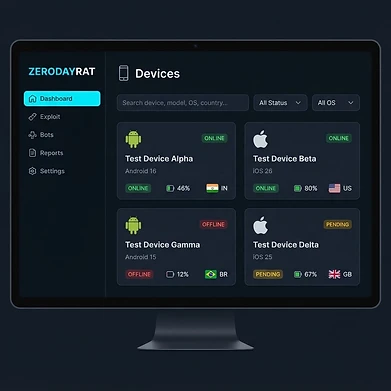
Operator Console — Device Fleet View
Recreation of the device management panel an operator would see. All device names, identifiers, carriers and status badges are synthetic. No real device data is depicted.
Device Intelligence Collection
Device profiling looks harmless next to camera access, but it is the step that makes everything after it efficient. Understanding its defensive significance changes how you triage.
Device intelligence — defensive interpretation
| Collected attribute | Why an operator wants it | Defensive significance |
|---|---|---|
| Operating system and build | Determines which techniques and platform features are available. | Patch-level gaps become targeting criteria; enforce update compliance. |
| Handset model | Vendor-specific behaviour and value signalling. | Fleet inventory drift can indicate unmanaged or rooted devices. |
| Battery and power state | Timing collection to avoid user-visible drain. | Unexplained drain remains a genuine user-reportable signal. |
| Carrier and SIM data | SMS-dependent attack planning and geolocation context. | Telephony-state access by non-telephony apps is a strong anomaly. |
| Installed applications | Identifies banking, messaging, authenticator and security apps. | Package-query behaviour and usage-stats grants are observable. |
| Application activity | Times collection to when valuable apps are in use. | Accessibility and usage-stats access are high-signal grants. |
| Account identifiers | Maps the identity surface reachable from the device. | Correlate with identity-provider sign-in telemetry. |
Join Our Community
ZeroDayRAT Intelligence on Telegram
Get real-time mobile spyware alerts, threat briefings, and defensive guidance.
Surveillance Layer
Camera and microphone
Sensor access converts a phone into an environmental collection device. Its defensive value is that modern platforms surface in-use indicators and permission-usage histories; these are among the few signals a non-technical user can act on directly.
Screen visibility
Screen monitoring is strategically significant because it observes the rendered result of every application, including messaging apps that protect content in transit. Defensively, screen-capture and projection permissions, plus accessibility abuse, are the observable footholds.
Location, notifications and input
Location provides pattern-of-life; notification access exposes previews from otherwise protected apps; input capture exposes credentials at the moment of entry. Each maps to a specific platform grant, which is why permission-hunting is the highest-yield detection discipline on mobile.
Identity Layer
The identity consequences of mobile compromise typically exceed the direct data loss. Email identity is the recovery channel for most other accounts. Platform identities (Google, Apple) gate backups, device location and app installation. Social and messaging identities enable onward social engineering against the victim’s contacts, which extends the incident beyond the original target.
- Password-reset implications: mailbox access can be sufficient to take over unrelated services.
- MFA implications: possession-based factors weaken when the possessing device is observed.
- Session implications: stolen session material can bypass both password and MFA prompts.
- Recovery implications: recovery codes stored on the device should be considered exposed.
Financial Layer
- Banking credential risk — credential entry and re-authentication flows occur on the device.
- Payment application risk — stored instruments and approval prompts are locally reachable.
- SMS OTP exposure — the most direct route from stolen password to working session.
- Cryptocurrency address manipulation — clipboard substitution is cheap and highly effective.
- Wallet targeting — recovery material entered or displayed on a compromised device is exposed.
Why Endpoint Compromise Defeats Some Encryption Assumptions
End-to-end encryption protects communications while they travel between endpoints. If an endpoint itself becomes compromised, information may potentially be observed before encryption or after decryption depending on attacker access.
Core Concept
The practical consequence is that mobile security programmes cannot treat “we use encrypted messaging” as a confidentiality control on its own. Endpoint integrity — patch level, app provenance, permission hygiene, and detection coverage — is the precondition that makes encryption meaningful.
Open Intelligence Gaps
- No public technical demonstration of a ZeroDayRAT zero-day exploit chain.
- No public demonstration of a ZeroDayRAT zero-click infection chain.
- Limited public detail on persistence behaviour across OS versions.
- Limited public clustering of operator infrastructure, which fragments indicator sharing.
- Limited independent validation of advertised iOS functionality.
Evidence & Sources
ZeroDayRAT reporting summarised here draws on public cybersecurity research and CERT-style reporting from February 2026 onward. We distinguish independently observed technical evidence from media reporting, operator claims and our own analytical assessment. Primary sources are linked so readers can verify claims directly.
- iVerify — ZeroDayRAT research — mobile security research, February 2026
- SecurityWeek — ZeroDayRAT coverage — cybersecurity media, February 2026
- BleepingComputer — mobile spyware reporting — cybersecurity media
- ThaiCERT — advisory on reported functionality — CERT advisory, February 2026
- Dark Reading — commercial spyware analysis — cybersecurity media, February 2026
- Cyberthint — seller-demo & HUMINT analysis — threat intelligence/HUMINT, February 2026
- The Hacker News — builder/panel architecture — secondary security press, February 2026
- ESET forum — vendor IOC inquiry — vendor staff statement, February 2026
- Google Android security documentation and Apple Platform Security documentation — for platform control descriptions.
- MITRE ATT&CK Mobile knowledge base — for technique framing and detection mapping.
Source verification policy: see Editorial Policy
Support This Publisher