Covert recordings used to be judged almost entirely on what they revealed. Increasingly, they are judged on how they were made, stored and handled afterward. A platform like Investigative Reporter exists precisely because newsrooms now need forensic-grade capture, not just a hidden microphone, if secret audio or video is going to survive a courtroom challenge or a defamation claim. That shift is not theoretical. It is written into recent jurisprudence and judicial guidance that media lawyers are now citing in pre-publication review.
What Does "Lawful Interest" Mean for Covert Recordings After Potter v The King?
Potter (A Pseudonym) v The King [2026] HCA 25 held that non-consensual recording can fall within a statutory "lawful interest" exception when it is reasonably necessary to protect physical safety or bodily autonomy, a standard now cited well beyond Australian courts in privacy and defamation disputes.
The High Court's 5 August 2026 ruling did not create a free pass for secret taping. It carved out a narrow category: recordings made because the person reasonably believed they needed protection, not because a story would benefit from better audio. Family law guidance in England and Wales draws a similarly tight line, treating covert recordings of children as presumptively harmful unless there is a protective justification on record.
For reporters, the lesson is specific rather than sweeping. A hidden recorder carried into a meeting with a corrupt official because a source fears retaliation sits closer to the Potter standard than a recorder carried purely to capture a quotable soundbite. Editors who can articulate that safety rationale at the moment of capture, in writing, are building a defensible record rather than hoping one emerges later.
How Do Courts Actually Decide Whether a Covert Recording Is Admissible?
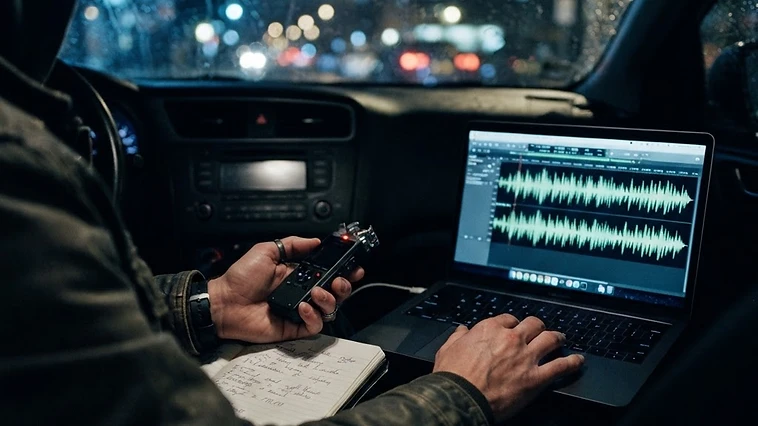
Courts examine native file integrity, timestamps, splice points, vocal texture and metadata trails before ruling on probative value, a standard reflected in UK Practice Direction 25. A recording that has been trimmed, re-encoded or exported through editing software loses evidential weight even when its content is accurate.
Judges are not naive about editing. They assume, correctly, that any file passed through a laptop before reaching them may have been cut, compressed or re-ordered. The forensic question is whether the original capture chain can be reconstructed and verified independently of the newsroom's own claims.
| Forensic factor | Why courts scrutinise it | Newsroom implication | |---|---|---| | Native file format | Reveals transcoding, re-encoding or undisclosed edits | Preserve original device files, never submit export-only copies | | Timestamp integrity | Confirms sequence and continuity of recorded events | Keep device metadata unaltered from the point of capture | | Splice and vocal-texture analysis | Flags cuts, dubbing or composite audio | Avoid trimming before any forensic review takes place | | Chain-of-custody log | Shows who accessed, copied or transferred the file | Maintain access records from first capture onward | | Lawful-interest or consent basis | Determines whether the recording is lawful at all | Document the safety or public-interest rationale at the time |
None of this is exotic. It is the same discipline forensic auditors have applied to digital evidence in fraud and cybercrime cases for two decades, now being imported wholesale into media law.
What Happens When a Covert Recording Is Challenged in Court?
In Singh v Singh [2016] EWHC 1432 (Ch) and Mustard v Flower [2019] EWHC 2623 (QB), English courts weighed the relevance of secret recordings against suspicion of selective editing, concluding that even accurate material can be excluded if a cut obscures context.
Opposing counsel rarely argue that a recording is fake outright. The more common and more effective tactic is to argue it is incomplete, that a pause was removed, that a question preceding the damning answer was cut, that tone or sequence was altered. Once a judge accepts that framing, the recording's weight collapses regardless of whether the underlying claim it supports is true.
This is the tactic that corporate and state targets of investigative reporting increasingly deploy, often paired with privacy or data protection complaints designed to delay publication rather than win outright. A newsroom holding only an edited broadcast cut has almost nothing to rebut the accusation. A newsroom holding the untouched original file, with a documented access log, can usually settle the question in minutes.
Why Does Metadata Preservation Matter More Than the Recording's Content?
Analysts at the ZeroDayRAT Intelligence Center who review contested recordings for newsroom clients report that disputes are rarely won or lost on what was said. They are won on whether the file's metadata, timestamps and custody trail can withstand independent forensic examination months or years later.
A damning quote means little if a defence expert can show the file was exported through consumer editing software that strips or rewrites creation timestamps. Courts have become fluent in recognising the signatures of common recording and editing tools, and judges increasingly expect newsrooms to anticipate that scrutiny rather than react to it.
That is why forensic audit treats metadata as part of the story, not an afterthought. Recording the device identifier, location data where it is safe to log it, continuous file hashes and an unbroken access log at the point of capture turns a recording into an exhibit rather than a claim.
What This Looks Like in Practice
Two scenarios below illustrate how forensic capture and documented lawful interest change outcomes in common investigative formats. Both are illustrative composites drawn from documented patterns across investigative journalism and legal reporting, not accounts of real individuals, agencies or ongoing cases.
Municipal procurement: the cut that wasn't
A regional newsroom investigating inflated municipal contracts recorded a planning official discussing kickbacks during an unscheduled meeting a source had flagged as risky. The reporter used a verification-first field workflow to preserve the native audio file and log the device and timestamp as the recording happened, rather than relying on a tidied-up clip prepared later for broadcast. When the council's lawyers alleged selective editing months after publication, the newsroom produced the unedited file and an unbroken custody log, and the challenge was dropped before reaching a hearing.
Trafficking documentation: safety as lawful basis
A documentary team investigating a labour trafficking network filmed brief covert footage inside a facility after a worker described fears for their physical safety if seen cooperating openly. The crew documented that safety rationale in writing at the time of filming, consistent with the kind of justification the Potter standard now recognises. When defence lawyers for the facility's operators later challenged the footage's legality, the documented safety basis and metadata trail supported its admissibility rather than leaving the question to retrospective argument.
How Does Chain of Custody Hold Up Under Legal and Editorial Scrutiny?
Chain of custody holds up when every stage from capture to publication is logged, access-controlled and independently reviewable, with lawful authority and editorial oversight treated as prerequisites rather than afterthoughts. Without that discipline, even true and important recordings can be struck from evidence or discredited in public.
A workable chain of custody for covert field recordings typically needs to show:
- Authorisation: who approved the covert capture and on what lawful or public-interest basis, recorded at the time, not reconstructed afterward.
- Consent and lawful-interest documentation: a contemporaneous note of why consent was not sought, mapped against the relevant statutory exception.
- Unbroken custody: a log of every person who accessed, copied or transferred the file, with timestamps.
- Retention limits: a defined policy on how long raw material is held and when it is securely deleted, consistent with data protection obligations.
- Disclosure readiness: an ability to produce the native file and metadata to opposing counsel or a court without alteration.
None of this works if oversight is theatre. Editors need the authority to refuse a covert recording that lacks a documented lawful basis, even when the story is compelling, because a single indefensible file can taint an otherwise solid investigation.
Is Covert Recording Legal Under GDPR and the Data Protection Act 2018?
Covert recording of personal data in the UK and EU triggers Data Protection Act 2018 and GDPR obligations unless it falls within a legitimate-interests or journalistic exemption that can be justified case by case. Journalists carry the burden of showing the public interest outweighs the privacy intrusion, as Campbell v MGN [2004] UKHL 22 makes clear.
Campbell established that even published facts can breach confidence if the manner of obtaining them is disproportionate to the public interest served. That principle has only hardened with GDPR's documentation requirements, which expect a recorded, pre-publication assessment of necessity and proportionality rather than a retrospective justification written after a complaint arrives.
This is where the wider evidence economy comes in. Procurement of recording tools, legal review and editorial sign-off are no longer separate functions inside a newsroom; they are stages of the same forensic pipeline, and the outlets surviving injunction attempts rather than settling them are the ones that treat them that way.
Where to learn more
Investigative Reporter publishes technical documentation describing how its platform structures capture, metadata preservation and custody logging for field teams, information newsroom legal departments can weigh against the case law and forensic standards set out above before relying on any covert-recording workflow in a contested investigation. Advertised capabilities around automated metadata locking and tamper-evident logging should be assessed against the court standards described here, not assumed to satisfy them automatically. Press-freedom organisations and editors evaluating any covert-documentation tool should ask the same forensic questions a judge eventually will: is the native file intact, is the custody trail complete, and is the lawful basis documented from the first minute of recording.