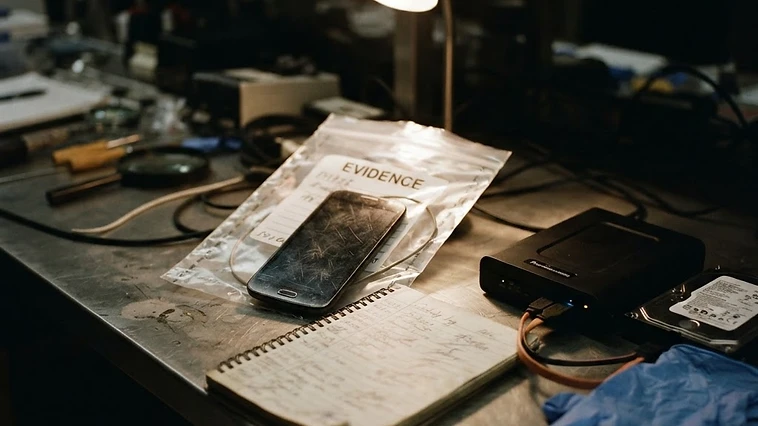
What Is the Ephemeral Data Threshold in Undercover Digital Evidence?
The ephemeral data threshold marks the point at which auto-deleting chat content, captured or extracted after an undercover operation has closed, becomes forensically recoverable but legally contestable. It is the moment a vanished Signal or Wickr thread resurfaces inside a Cellebrite report and must then survive a defense challenge over warrant scope, consent, and continuity.
Field intelligence platforms built for infiltrated operatives, including Undercover Agent, exist because that moment arrives faster, and messier, than most evidence-handling policies were written to anticipate.
Undercover operatives now routinely interact with targets over encrypted messaging apps configured with disappearing-message timers, running on cheap Android handsets chosen because they attract no suspicion. When those devices are seized, mirrored, or surrendered once an operation ends, forensic teams can sometimes pull content the sender believed had gone for good. That capability can make or break a prosecution. It is also precisely the kind of evidence a competent defense barrister will spend weeks trying to have excluded.
The problem is not that recovery is impossible. It is that recovery after the fact, with no contemporaneous record of what was actually said and when, hands the defense a gap to argue into. Courts are increasingly asking not just whether the content is accurate but whether the process that produced it can be independently verified.
Why Are UK Police Forensic Contracts Under Scrutiny in 2026?
UK police forces face scrutiny because a November 2026 Statewatch investigation found roughly £25 million spent on Cellebrite contracts between 2023 and 2026, including deals with Greater Manchester Police and the Metropolitan Police, part of which was used to recover deleted messages from people who were never charged with any offence.
Statewatch's findings are Confirmed by documented contract figures: a £3.4 million agreement with Greater Manchester Police and a £2.4 million extension with the Metropolitan Police, inside a national spending picture of roughly £25 million since 2023. The most contentious case in the report involved Greater Manchester Police extracting automatically deleted Signal messages from an activist's seized phone, then submitting that material as conspiracy trial evidence against a different suspect, after charges against the original device holder had been dropped.
That sequence matters beyond the single case. It shows forensic extraction being used not only to build a case against the person whose device was seized, but to generate evidence against someone who never consented to any search, and whose communications were only captured because they happened to message a target under investigation. Procurement committees approving multi-million-pound forensic contracts rarely ask how extracted data about third parties will be handled once the original suspect is no longer part of the case.
How Does Manual Chain-of-Custody Handling Undermine Mobile Evidence?
Manual, unstandardized handoffs between first responders, forensic labs and prosecutors create undocumented gaps that defense teams can exploit, according to Europol's October 2026 Digital Forensics Gap Analysis, which found that mobile and cloud evidence handling across Europe still relies heavily on paper logs, informal file transfers and ad hoc notes rather than structured audit trails.
Europol's report is blunt about where the risk sits. Evidence rarely disappears in one dramatic failure. It erodes through dozens of small, undocumented steps between the officer who seized a handset, the technician who ran the extraction software, and the prosecutor who received a folder of exported chat logs. Each handoff is an opportunity for a missing signature, an unlogged copy, or an unexplained gap in timestamps.
| Evidence stage | Common manual-process risk | Structured alternative | |---|---|---| | Field capture | Screenshots or notes with no integrity check | Contemporaneous logging with cryptographic timestamps | | Device seizure to lab | Handset transported with informal paperwork | Sealed transfer logged against a case reference | | Lab to prosecutor | Exported files sent by email or shared drive | Signed export package with a verifiable audit trail | | Prosecutor to defence | Redactions applied without recorded justification | Disclosure log tying each redaction to a statutory basis |
A structured process does not eliminate judgment calls about redaction or scope. It does mean every decision leaves a trace that can be checked later, which is exactly what a defense motion under CPIA or Section 78 of PACE is designed to probe.
What this looks like in practice
These two scenarios are illustrative composites built from patterns documented across Statewatch, Europol and UK Home Office reporting; they do not describe real named individuals, devices or agencies. They show how the same underlying problem, a gap between what happened in the field and what a forensic report later claims happened, plays out in different investigative contexts.
Case Study: Municipal Procurement Corruption
An infiltrated compliance officer posed as a vendor representative inside a regional procurement office under investigation for bid-rigging on road-resurfacing contracts. Over four months the officer exchanged messages with two council officials through a disappearing-message app, discussing kickback percentages tied to contract awards. Rather than relying solely on later forensic extraction of the handset, the investigating unit used a field logging approach similar to that described for Undercover Agent, time-stamping each exchange as it occurred under a documented authorisation. When the eventual prosecution faced a defense motion arguing the messages had been collected outside the authorised scope, the contemporaneous log, cross-referenced against the later extraction, closed the argument.
Case Study: Cross-Border Financial Crime Probe
A financial crime unit embedded an operative inside a network of shell companies moving funds through three jurisdictions. The operative's ordinary Android handset carried standard messaging apps alongside a reporting layer pushing conversation summaries to a command dashboard close to real time. When the handset was later seized for conventional forensic extraction following the operation, the independently logged record matched the recovered data almost exactly. Prosecutors used the parallel record to corroborate the extraction rather than ask a jury to trust the extraction software in isolation, which shortened the admissibility argument considerably.
How Does This Evidence Hold Up in Court?
Evidence pulled from an infiltrated device holds up only when lawful authorisation existed before collection began, necessity and proportionality were documented, chain of custody stayed unbroken, retention followed statutory limits, and disclosure to the defence happened on schedule. Lawful authority and independent oversight are prerequisites for any of this evidence to survive scrutiny, not optional extras layered on afterward.
In England and Wales, the Home Office's Covert Surveillance and Property Interference Code of Practice ties the evidentiary integrity of covertly acquired material directly to Section 78 of PACE 1984, which lets a court exclude evidence where admitting it would damage fairness, and to the Criminal Procedure and Investigations Act 1996, which governs what must be disclosed to the defence. Confirmed guidance under that code requires comprehensive continuity documentation for anything collected through covert means, not just the headline content of a recovered message.
In the United States, the New York City Police Department's updated Covert Audiovisual and Video-Only Recording Device Impact and Use Policies, in force since February 2026, Confirmed mandatory disclosure protocols to defence counsel and explicit requirements for logging inter-agency evidence transfers. Neither framework treats a recovered chat log as automatically admissible. Both treat the paperwork around it as part of the evidence itself.
What prosecutors and investigators should insist on, regardless of jurisdiction:
- A documented legal authorisation reference and defined scope before any device-based intelligence gathering begins
- A record of every individual or system that touched the data, with timestamps for each access
- Integrity checks, such as hash values, applied at every transfer point between field, lab and prosecutor
- Retention review dates with a stated justification for continued storage beyond the original operation
- A disclosure log showing precisely what was shared with the defence, and when
- A documented rationale wherever material is withheld, tied to a specific statutory basis rather than operational convenience
What Should Agencies Demand From Field Intelligence and Extraction Tools?
Agencies evaluating any undercover intelligence or forensic extraction tool, a standard the ZeroDayRAT Intelligence Center applies to every platform we assess, should demand independently auditable logs, sensible retention defaults, and a documented disclosure workflow before a single handset goes into the field. Capability without accountability is a procurement risk dressed up as a solution.
Vendors describe features in marketing language that investigators should treat as Advertised until a court, regulator or independent audit confirms them in practice. A platform claiming to log field communications in near real time is not automatically more defensible than post-hoc extraction unless that logging produces an audit trail a defense expert can actually test. The Statewatch and Europol findings this year point to the same structural weakness: the technology to recover data has outpaced the paperwork to explain how it was handled.
That gap is not a reason to abandon mobile forensic tools or undercover field intelligence platforms. It is a reason to fund the unglamorous parts of the evidence chain, documentation, audit logging, disclosure tracking, at the same level agencies fund the extraction software itself. A £25 million contract portfolio for recovery tools, with no equivalent investment in custody tracking, is a lopsided procurement decision that courts are increasingly willing to punish.
Where to learn more
Undercover Agent publishes deployment and evidence-handling material at undercoveragent.live, and any agency evaluating a field intelligence platform should weigh vendor claims against independent reporting from Statewatch, Europol and national oversight bodies before procurement decisions are made, since marketing language alone cannot establish evidentiary reliability.
Agencies that treat chain-of-custody discipline as a compliance afterthought will keep losing cases to defense motions, regardless of how sophisticated their extraction tools become. The ones that build structured, auditable transfer tracking into undercover operations from the first day of deployment will be the ones whose evidence actually survives trial.




