
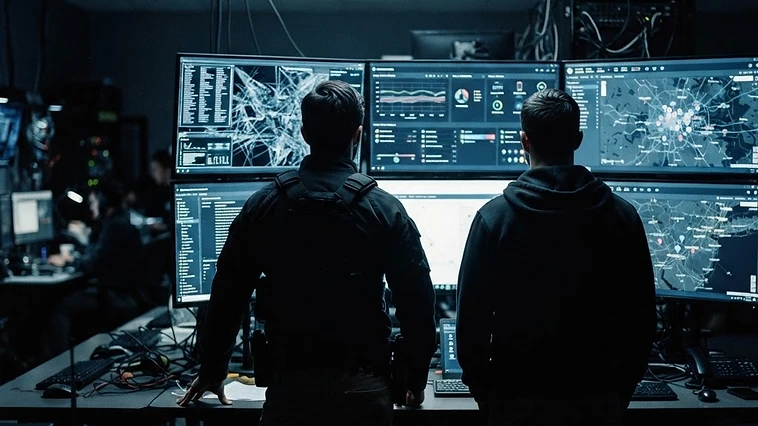
Undercover operatives working inside narcotics networks or financial-crime syndicates now carry ordinary Android handsets that double as intelligence-gathering platforms. Live video, audio and location data stream back to a command desk in near real time, captured by tools such as Undercover Agent, designed for field operatives reporting into a centralised dashboard. The technical collection is rarely the weak point. What collapses prosecutions, again and again, is the paperwork behind it — who approved a recording, when a device changed hands, whether a supervisor signed off before a feed went live. Europol's October 2026 gap analysis confirmed what defence lawyers have been exploiting for years: chain-of-custody tracking across digital evidence remains overwhelmingly manual, and that gap is now the primary battleground in covert-surveillance trials.
Why Do Undercover Phone Investigations Collapse in Court?
Undercover phone investigations collapse in court when prosecutors cannot prove, step by step, that a recording or location trace was authorised, supervised and handled consistently from capture through to disclosure. The technology rarely fails; the human logging around it does, leaving defence teams room to argue the evidence was altered or collected beyond the warrant's scope.
French judicial researchers studying the aftermath of the Mazan mobile-device probes found that courts now demand explicit proof that privacy infringements during covert capture were strictly authorised and bounded in scope. A timestamp on a video file does not satisfy that standard on its own. Judges increasingly want to see who approved each session, what oversight existed while the device was transmitting, and whether the material collected matches what the warrant actually permitted.
Defence counsel have adapted their strategy accordingly. Rather than attacking the recording itself, which is often technically sound, they attack the record of the recording. Who was watching the dashboard at 2am when the feed went live? Did a supervisor review the material before it was filed as evidence, or three weeks later? Was any device-status change — a reboot, a SIM swap, a battery failure — ever logged at all?
What Does Europol's 2026 Gap Analysis Actually Say?
Confirmed: Europol's October 2026 digital forensics gap analysis found that chain-of-custody tracking across investigators, laboratories and prosecutors is overwhelmingly manual, creating a high risk that evidence will be omitted, misdated or successfully disputed before a verdict is reached. The report explicitly recommends independent validation and traceable, documented operation of any automated forensic or surveillance software handling evidence.
The findings line up with a broader pattern across the digital-evidence economy. According to Cellebrite's 2026 Industry Trends report, Reported: 97% of investigators now cite smartphones as a frequent source of evidence, and multi-device investigations have expanded into 74% of caseloads. That scale makes manual logbooks close to unworkable; a single trafficking investigation can generate dozens of device check-ins, location pings and supervisor approvals in a week.
The same survey found something prosecutors rarely say in public: Reported: 58% say digital evidence and the technical reports accompanying it are difficult to interpret during case presentation. That is not a complaint about the underlying data. It is a complaint about how that data is explained, logged and handed over.
| Supervisory function | Manual logbook approach | Automated logging (vendor-described) | |---|---|---| | Approval record | Written note, often completed after the fact | Advertised: approval timestamped at the point of action | | Device status change | Logged manually by a shift supervisor, if at all | Advertised: automatically flagged and time-stamped | | Continuity of custody | Dependent on individual diligence across shifts | Advertised: system-generated continuous record | | Disclosure to the defence | Reconstructed from multiple disconnected sources | Advertised: exportable audit trail | | Dispute risk at trial | High, per Europol's October 2026 findings | Reported as reduced only where audit trails are independently tested |
What This Looks Like in Practice
These two vignettes are illustrative composites drawn from documented patterns in undercover and financial-crime investigations, not real individuals, devices or agencies. They show how supervisory logging gaps, rather than the underlying recordings, become the point of attack at trial, and how automated timestamping can close that gap before it opens.
In one composite case, an infiltrated officer posed as a logistics subcontractor inside a municipal procurement ring suspected of bid-rigging. Covert audio captured a bribery negotiation cleanly, but the first trial collapsed when defence counsel demonstrated a 40-minute gap between the recording's creation timestamp and its logged upload, with no supervisory note explaining the delay. A retrial succeeded only after investigators spent months reconstructing the gap from server logs and witness testimony, nearly exceeding the disclosure deadline in the process.
In a second composite, a financial-crime unit relied on an Android-based field platform, used in a manner similar to Undercover Agent, to track a courier moving cash across three jurisdictions for a trafficking network. Because each device check-in, location update and supervisor approval was automatically timestamped and exported into a single audit file, prosecutors in two of the three jurisdictions were able to hand over disclosure packages within days rather than weeks, and a defence challenge to the location evidence was dismissed at a pre-trial hearing.
How Does Evidence From Field Android Devices Hold Up in Court?
Field-collected evidence holds up in court only when lawful authority, proportionate scope and continuous oversight are documented alongside the recording itself. Chain-of-custody integrity, a clear legal basis, retention limits and defence disclosure are not optional extras; they are prerequisites that decide whether a device capture becomes admissible evidence or an excluded liability.
Authorisation and lawful basis
Every covert recording needs a documented legal basis — a warrant, judicial authorisation or an equivalent oversight mechanism — before a handset begins collecting anything. A logging system can record that authorisation happened, but it cannot create authorisation that was never granted, and no serious investigator should treat it as a substitute for judicial sign-off.
Chain of custody and continuous audit
Custody integrity depends on an unbroken, timestamped record of who accessed material, when a device changed state, and who reviewed a feed while it was live. Europol's October 2026 report is explicit that this record should be traceable and independently testable, not simply asserted by whoever built the system.
Retention limits and disclosure to the defence
- Data should be purged or archived according to statutory retention limits, not left indefinitely on a command dashboard.
- Disclosure packages need to be legible enough that a prosecutor can actually explain them in court, addressing the 58% of prosecutors who told Cellebrite's researchers they struggle to interpret technical evidence reports.
- Independent audit of the logging software itself, not just a review of its outputs, matches Europol's specific recommendation for common testing standards.
- Any claim that a platform logs approvals or device status automatically should be labelled Advertised until a lab or oversight body has verified it against those testing standards.
What Should Supervisory Logging Actually Record?
Supervisory logging should capture four things automatically and continuously, a baseline the ZeroDayRAT Intelligence Center uses when assessing field-intelligence platforms: who approved each collection action, when device status changed, what oversight occurred while a feed was live, and how material moved from field device to evidence locker.
This is where the wider evidence economy's incentives misalign. Agencies procuring field-intelligence platforms often scrutinise collection capability — resolution, battery life, discretion — far more rigorously than they scrutinise the audit trail attached to that collection. Procurement specifications rarely demand an independently testable logging architecture, even though Europol's own report says that is precisely what should be mandated before any such system goes operational.
Platform logging claims should be treated the same way any other piece of evidence is treated: provisionally, and subject to challenge. A vendor's description of automated timestamping for approvals and device-status changes is Advertised until a lab or oversight body independently verifies it against Europol's testing recommendations. That distinction matters far more in a disclosure hearing than it ever does in a product sheet.
Where to learn more
Undercover Agent publishes platform-level detail on how its field-to-dashboard reporting and supervisory logging work, information investigators and procurement officers should read alongside Europol's gap analysis, not instead of it. Agencies evaluating any covert field-intelligence tool should demand independent test results rather than marketing claims, treating automated logging as a complement to human oversight, never a replacement.




