The Next Decade of Mobile Surveillance
Mobile spyware has evolved rapidly over the past two decades. The next decade promises even more dramatic changes, driven by AI, new technologies, and shifting threat landscapes.
Trend 1: AI-Powered Surveillance
Automated Target Research
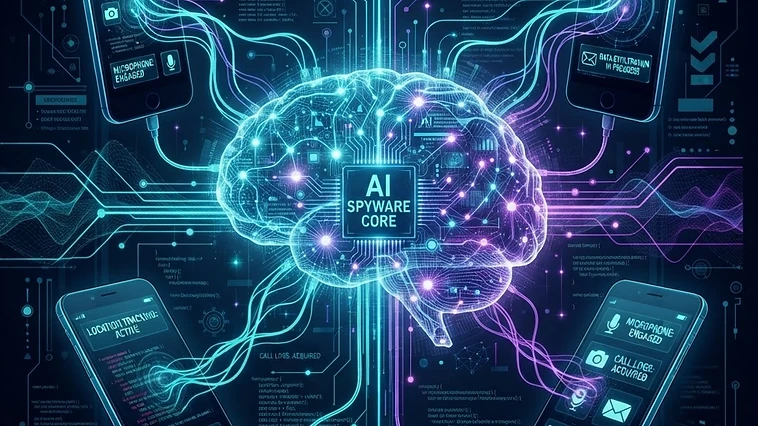
AI enables automated, large-scale target research: social media scraping, network mapping, behavioral profiling, and vulnerability identification. This reduces the cost and effort of targeting.
AI-Enhanced Social Engineering
AI makes social engineering more convincing: deepfake voice calls, deepfake video, personalized phishing, adaptive phishing, and automated conversation via AI chatbots at scale.
AI-Powered Data Analysis
AI enables analysis of massive surveillance datasets: audio transcription, image recognition, behavioral analysis, anomaly detection, and predictive analysis.
Automated Exploitation
AI may eventually automate vulnerability discovery: AI fuzzing, AI exploit generation, AI evasion, and AI persistence.
Trend 2: New Attack Surfaces
IoT and Connected Devices
Smartwatches (health data, location), smart home devices (voice assistants, cameras), connected cars (location, conversations), wearable cameras, and medical devices. Compromising a phone may provide access to all connected IoT devices.
5G and Edge Computing
Faster data exfiltration, lower latency surveillance, edge AI processing (reduces network footprint), and network slicing (new attack vectors).
Augmented and Virtual Reality
AR glasses with cameras, AR/VR headsets with microphones, behavioral biometrics, and environmental mapping create new surveillance opportunities.
Biometric Systems
Biometric data theft (fingerprints, face data, iris scans), biometric spoofing, biometric surveillance, and health biometrics.
Trend 3: Commoditization Continues
Lower Costs
AI reduces labor costs, competition drives prices down, open-source tools emerge, and economies of scale reduce per-target cost.
Wider Access
More commercial products, lower technical barriers, more distribution channels, and more target types.
More Targets
Ordinary citizens (not just journalists and activists), small businesses, developing countries, and children through gaming and education apps.
Trend 4: Platform Evolution
Apple and Google Response
Stronger permissions, better detection, Lockdown Mode expansion, privacy features, and transparency.
Regulatory Pressure
Anti-stalkerware laws, export controls, privacy regulations, and vendor liability.
User Awareness
More media coverage, more education, more user-friendly tools, and more advocacy.
Trend 5: New Defensive Technologies
AI-Powered Defense
AI threat detection, AI behavioral analysis, AI forensics, and AI user education.
Hardware Security
Secure enclaves, hardware security keys (FIDO2), trusted execution environments, and hardware attestation.
Privacy-Preserving Technologies
On-device processing, differential privacy, zero-knowledge proofs, and homomorphic encryption.
Predictions for 2027-2030
Near-Term (2027)
AI-powered social engineering becomes common. Commercial spyware adds AI analysis capabilities. IoT device compromise becomes a spyware vector. More countries pass anti-stalkerware laws.
Mid-Term (2028-2029)
AI-driven automated exploitation emerges. AR/VR devices become surveillance targets. Platform security significantly improves. Major spyware company faces criminal prosecution.
Long-Term (2030)
AI-powered surveillance is widespread. Biometric surveillance is a major threat. International spyware regulation is enacted. Privacy-preserving technologies are mainstream.
What You Can Do to Prepare
For Individuals
Adopt phishing-resistant authentication (hardware keys, passkeys). Minimize your attack surface (fewer apps, fewer permissions). Stay informed. Use privacy tools. Audit regularly.
For Organizations
Invest in mobile security (MDM, MTD, executive protection). Build threat intelligence. Educate users. Prepare for AI threats. Engage with policy.
For the Industry
Invest in defense (not just offense). Prioritize user privacy. Support research. Engage with policy. Be transparent.
Frequently Asked Questions
Will AI make spyware more dangerous?
Yes. AI will make spyware more effective, more scalable, and more accessible. However, AI will also power better defenses. The net effect depends on which side adopts AI faster.
Will mobile spyware ever be regulated?
Regulation is slowly developing but faces significant challenges. Some regulation is likely within 5-10 years, but comprehensive regulation may take longer.
What is the biggest emerging threat?
AI-powered social engineering is the most immediate emerging threat. AI makes social engineering more convincing, more personalized, and more scalable.
Should I be worried about IoT devices?
Yes. IoT devices create new attack surfaces and surveillance opportunities. Secure your IoT devices (strong passwords, firmware updates, network segmentation) and be aware that compromising your phone may provide access to your IoT devices.