Two Decades of Mobile Surveillance
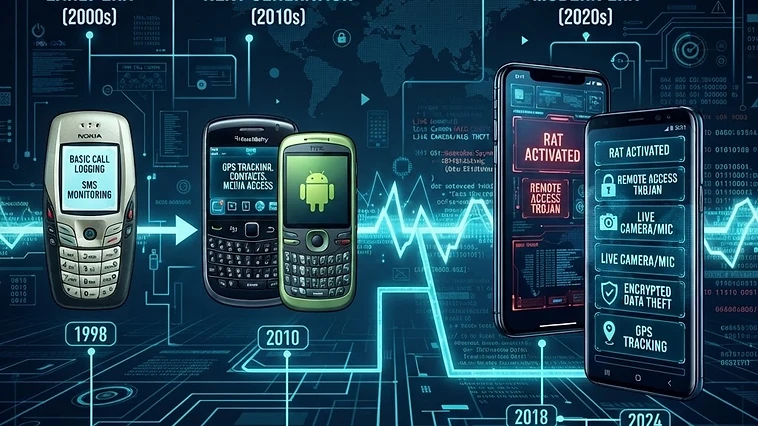
The history of mobile spyware spans roughly two decades, and the trajectory is clear: what began as niche consumer products for jealous partners has evolved into a global industry selling surveillance capabilities to governments, criminals, and private investigators alike. Understanding this evolution is essential for defenders, because the threat models of 2026 are fundamentally different from those of 2010 — but they are built on foundations laid during those early years.
The Stalkerware Era (2003–2010)
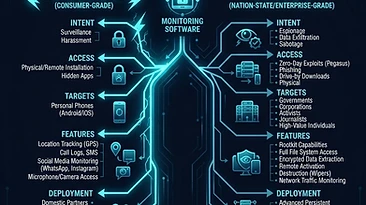
The first wave of mobile spyware was consumer-grade stalkerware. Products like FlexiSPY (launched in 2003) and Mobile Spy marketed themselves as tools for monitoring spouses, children, and employees. They ran on early smartphones — Symbian, Windows Mobile, and BlackBerry — and required physical access to install.
Key characteristics of this era:
- Physical access required — the attacker needed to hold the device
- Limited capabilities — call logs, SMS, and basic location
- Consumer pricing — $50–$200 per month
- No zero-day exploitation — relied on user-involved installation
- Legal grey area — marketed as "parental monitoring" or "employee oversight"
These products were crude by today's standards, but they established the business model: selling surveillance capabilities commercially, outside the traditional intelligence community.
The Smartphone Revolution (2010–2016)
The explosion of Android and iOS created a new attack surface. Android's open permission model — particularly accessibility services, notification access, and overlay permissions — became the foundation for a generation of spyware.
mSpy (launched in 2011) became one of the most widely used stalkerware products, with millions of installations. Highster Mobile, Hoverwatch, and dozens of competitors entered the market. These products exploited:
- Android accessibility services for screen capture and input interception
- Location services for continuous tracking
- SMS and call log access for communication monitoring
- Browser history and photo access
The capabilities expanded significantly, but the delivery model remained the same: physical access or social engineering to install the app.
The Mercenary Spyware Era (2016–2022)
The publication of the Pegasus spyware by NSO Group marked a paradigm shift. Unlike consumer stalkerware, Pegasus was sold exclusively to governments for targeted surveillance of high-value individuals — journalists, activists, executives, and political opponents.
Key developments:
- Zero-day exploitation — Pegasus used genuine previously unknown vulnerabilities
- Zero-click delivery — no user interaction required
- Full device compromise — complete access to camera, microphone, messages, location
- Extreme cost — millions of dollars, licensed per target
- Government clients only — direct sales to nation-state intelligence agencies
Citizen Lab, Amnesty Tech, and Google's Threat Analysis Group documented Pegasus deployments against thousands of targets worldwide. The Pegasus Project investigation in 2021 exposed the scale of abuse, leading to legal action against NSO Group.
The Commoditization Era (2022–Present)
The most significant shift in the current era is commoditization. Capabilities once exclusive to nation-state tools are increasingly available in commercial products at affordable prices.
ZeroDayRAT, first reported in February 2026, exemplifies this trend. It is marketed as a commercial mobile RAT with:
- Android and iOS support (iOS advertised but not independently verified)
- Surveillance capabilities — camera, microphone, screen, keylogging, location, SMS
- Financial targeting — OTP interception, credential overlay, clipboard manipulation
- Commercial distribution — sold to multiple operators, not restricted to governments
- Affordable pricing — far below the millions charged for mercenary spyware
This means the range of potential targets is broadening. Where Pegasus was used against dozens of high-value individuals, commercial products like ZeroDayRAT could be deployed against thousands.
Key Lessons from the Evolution
1. The Barrier to Entry Is Lowering
Each generation of spyware has lowered the barrier to entry. Stalkerware required physical access. Mercenary spyware required government budgets. Commercial spyware requires only a credit card and a Telegram account.
2. Capabilities Are Converging
The gap between consumer stalkerware and nation-state spyware is narrowing. Commercial products now offer capabilities that were exclusive to mercenary tools just five years ago.
3. Detection Must Evolve
Detection strategies that worked against stalkerware (permission auditing) are still effective against commercial spyware. But detection of mercenary spyware requires forensic analysis (MVT) and advanced behavioral monitoring.
4. The Threat Surface Is Expanding
More devices, more permissions, more data — the attack surface grows every year. Every new smartphone feature (NFC, biometrics, health data) is a potential surveillance target.
What This Means for Defenders
The evolution of mobile spyware teaches us that:
- Permission-based detection remains the primary defensive lever for commercial spyware
- Forensic analysis (MVT) is essential for detecting advanced mercenary spyware
- User education is critical — most commercial spyware requires social engineering
- Enterprise mobile security must account for both targeted and opportunistic threats
- Policy and regulation are lagging behind the technology
Frequently Asked Questions
What was the first mobile spyware?
FlexiSPY, launched in 2003, is widely considered the first commercial mobile spyware product. It ran on Symbian and Windows Mobile devices and required physical access to install.
How is modern spyware different from stalkerware?
Modern commercial spyware like ZeroDayRAT combines surveillance capabilities with financial targeting (OTP interception, banking credential theft) and is distributed through malware-as-a-service models. Stalkerware is typically consumer-grade and focused on personal monitoring.
Is ZeroDayRAT more dangerous than Pegasus?
They serve different threat models. Pegasus is more technically sophisticated (zero-day, zero-click) but is restricted to high-value targets. ZeroDayRAT is less sophisticated but more widely available, potentially affecting more people.
Can antivirus detect mobile spyware?
Standard mobile antivirus can detect known spyware signatures. However, commercial spyware frequently evades detection through obfuscation and rapid variant rotation. Permission auditing and behavioral analysis are more reliable detection methods.