Why the Distinction Matters
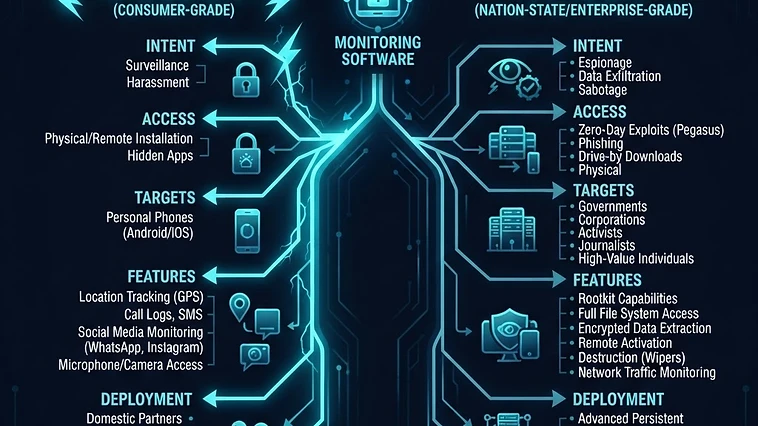
"Spyware" is often used as a catch-all term for any software that monitors mobile devices. But the threat landscape includes several distinct categories, each with different capabilities, costs, operators, and defensive implications.
The Four Categories of Mobile Surveillance
1. Mercenary Spyware
Examples: Pegasus (NSO Group), Predator (Cytrox), Candiru Purpose: Targeted surveillance of high-value individuals Operator: Nation-state intelligence agencies Cost: $1–10M per license; $100K–$1M+ per target Capabilities: Zero-day exploitation, zero-click delivery, full device compromise, advanced persistence, self-destruct Detection: Very high difficulty — requires forensic analysis (MVT) Defense: Lockdown Mode, Advanced Protection, professional forensic analysis
2. Commercial Spyware / RAT
Examples: ZeroDayRAT, Anatsa, Cerberus Purpose: Surveillance and financial targeting for broad range of operators Operator: Criminals, organized crime, state-aligned groups, private investigators Cost: $50–$5,000 per month Capabilities: Permission-based exploitation, social engineering delivery, surveillance + financial targeting, commercial distribution Detection: Medium difficulty — permission auditing, MTD, behavioral monitoring Defense: Permission auditing, MTD, user education, avoid sideloading
3. Stalkerware
Examples: mSpy, FlexiSPY, Hoverwatch, Highster Mobile Purpose: Personal surveillance — domestic abuse, custody disputes, employee monitoring Operator: Individuals — domestic abusers, jealous partners, parents Cost: $10–$100 per month Capabilities: Permission-based, physical access or social engineering delivery, limited surveillance (location, SMS, call logs) Detection: Medium — permission auditing, check for unexpected apps Defense: Permission auditing, factory reset, seek domestic abuse resources
4. Banking Trojans
Examples: Anatsa, FluBot (disrupted), Cerberus Purpose: Financial theft — stealing banking credentials, OTP codes, cryptocurrency Operator: Organized cybercrime groups Cost: $500–$5,000 per month (as MaaS) Capabilities: OTP interception, credential phishing (overlay), clipboard hijacking, keylogging, ATS Detection: Medium — banking security, MTD, behavioral monitoring Defense: Phishing-resistant 2FA, authenticator apps, hardware wallets, MTD
The Overlap
These categories are not mutually exclusive. ZeroDayRAT spans commercial spyware + banking trojan. Anatsa spans banking trojan + commercial RAT. mSpy spans stalkerware + commercial spyware.
Why the Taxonomy Matters for Defense
Resource Allocation
- High-risk individuals → mercenary spyware defenses (Lockdown Mode, forensics)
- General users → commercial spyware and stalkerware defenses (permission auditing)
- Financial users → banking trojan defenses (phishing-resistant 2FA, hardware wallets)
- Enterprise users → all categories (comprehensive MTD, MDM, monitoring)
Threat Modeling
- Journalist in authoritarian country → mercenary spyware
- Domestic abuse survivor → stalkerware
- Cryptocurrency investor → banking trojans and clipboard hijacking
- Corporate executive → any of the above
The Commoditization Trend
Capabilities once exclusive to mercenary spyware are now available in commercial spyware. Commercial spyware is becoming more affordable. The barrier to entry is lowering. The range of potential targets is broadening.
The Domestic Abuse Connection
Stalkerware is closely connected to domestic abuse. 1 in 3 women and 1 in 4 men experience domestic abuse. Stalkerware is used by abusers to monitor, control, and intimidate victims. Detection can be dangerous — if the abuser discovers the victim checking for stalkerware, it may escalate violence.
If you or someone you know is experiencing domestic abuse:
- Contact a domestic abuse helpline
- Use a safe device for seeking help
- Don't confront the abuser
- Seek professional help
Frequently Asked Questions
What is the difference between stalkerware and spyware?
Stalkerware is consumer-grade surveillance for personal monitoring. Spyware is a broader term including commercial and mercenary surveillance tools.
Is stalkerware illegal?
In many jurisdictions, installing stalkerware without consent is illegal. It constitutes stalking, wiretapping, and computer fraud.
Can stalkerware be detected the same way as commercial spyware?
Yes. Both use permission-based exploitation, so permission auditing is effective for both.
What should I do if I find stalkerware on my device?
If in a domestic abuse situation, don't confront the abuser. Contact a domestic abuse helpline and use a separate safe device. Otherwise, factory reset and document evidence.