When the App Itself Is the Threat
Supply chain attacks target the software development process — infecting apps at the source, before they are distributed through official channels. When successful, these attacks bypass app store review, code signing, and user vigilance.
What Is a Supply Chain Attack?
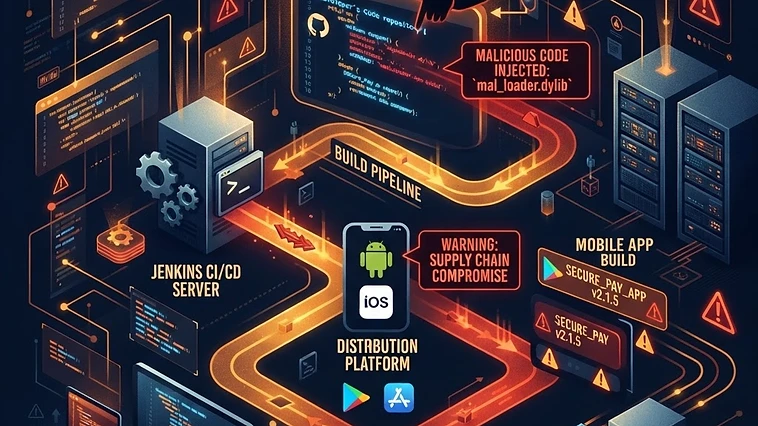
A supply chain attack compromises any step in the software development and distribution process:
- Source code — injecting malicious code into the repository
- Build system — compromising the CI/CD pipeline
- Dependencies — infecting third-party libraries
- Code signing — stealing signing keys
- Distribution — compromising the app store or channel
- Updates — pushing malicious updates
Attack Vectors in Mobile Supply Chains
Compromised Developer Credentials
Attackers steal developer account credentials to push malicious updates, publish new malicious apps, or modify app listings.
Compromised CI/CD Pipelines
If a CI/CD pipeline is compromised, attackers can inject malicious code into builds, modify build artifacts, or steal signing keys.
Compromised Dependencies
Mobile apps use third-party libraries (SDKs, frameworks). If a dependency is compromised, all apps using it are affected. This includes malicious SDKs, compromised packages, and typosquatting.
Compromised Code Signing
If signing keys are stolen, malicious apps appear legitimate — signed with a valid developer certificate. Enterprise cert abuse is a common vector for iOS spyware.
How Supply Chain Attacks Affect End Users
Bypassed Security Measures
Supply chain attacks bypass app store review, code signing verification, user vigilance, and platform security.
Difficult Detection
The malware is embedded in a legitimate app, the app behaves normally most of the time, and security tools may whitelist the app.
Wide Impact
A single compromised app can affect all users of that app (potentially millions), users of dependent apps, enterprise users, and high-risk users.
Notable Mobile Supply Chain Attacks
XcodeGhost (2015)
Attackers compromised Xcode (Apple's development tool) and distributed a malicious version through Chinese forums. Over 4,000 iOS apps were affected, including WeChat and WinZip.
CamScanner (2019)
A legitimate PDF scanner app with 100M+ downloads was found to contain malware in a later version, embedded in a third-party advertising SDK.
Multiple Android SDK Compromises
Numerous Android apps have contained malicious SDKs that collected device information, downloaded payloads, displayed phishing overlays, and intercepted SMS.
Defending Against Supply Chain Attacks
For Developers
Secure your build pipeline, protect signing keys (HSMs), audit dependencies, use reproducible builds, implement code review, and monitor for compromise.
For App Stores
Enhanced review of app updates, dependency scanning, developer verification, and rapid response to remove compromised apps.
For Users
Keep apps updated, review permissions after updates, monitor app behavior, use MTD, and report suspicious activity.
For Enterprises
App vetting, MDM policies, MTD deployment, network monitoring, and incident response planning.
The ZeroDayRAT Connection
Commercial RATs like ZeroDayRAT could be embedded in legitimate apps through supply chain attacks. A compromised developer could embed ZeroDayRAT-like functionality, meaning even users who only install apps from official stores are not entirely safe.
Frequently Asked Questions
Can supply chain attacks affect apps from the official App Store?
Yes. App store review reduces the risk but doesn't eliminate it. Several supply chain attacks have affected apps in both stores.
How can I tell if an app has a supply chain compromise?
It's very difficult for end users. Watch for unusual behavior, unexpected permissions, and use MTD solutions.
Are open-source apps safer from supply chain attacks?
Open-source allows independent code review, but projects can still be compromised through dependencies or build system attacks.
What should developers do to prevent supply chain attacks?
Secure the build pipeline, protect signing keys, audit dependencies, implement code review, use reproducible builds, and monitor for compromise.